Brickmaking

"You could cross through 'Claybank' (below) and put in 'Medora' then change the names of people pictured and it would all be the same as how it was at the Medora Plant."
- Long-time Medora Brick Plant Superintendent, Bernard A. Gray of Medora
There are additional interesting facts about brickmaking at the Medora plant included in the Bernard Gray interviews on this website.
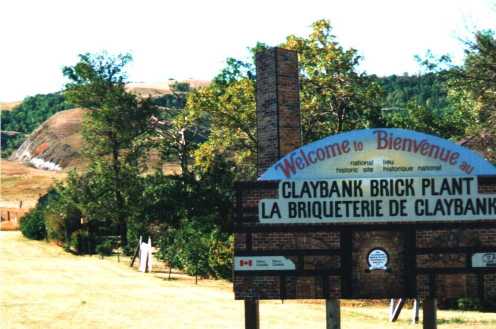
The 19th century brick making technology that carried through much of the 20th century is demonstrated in the text and photos below. However, all is from the Claybank Brick Plant, Claybank, Saskatchewan, Canada - a preserved property and national historical site of very similar vintage and lifespan. Text and photos are of the Claybank Brick Plant and are kindly shared and appear here with permission.
Thank You to Frank Korvemaker, Hilda Maier and Doug Pugh
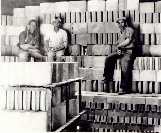
Tossers and etters would load the kiln for firing. The setters made sure to leave air spaces between the brick so they would fire evenly.
L to R: Bill Wallace (Tosser), John A. Achtemichuk (Setter) and John E. Achtemichuk (Setter). 1936 Claybank Brick Plant Site
The Brick cart loaded with green brick was rolled into a kiln using Portable Track. The tossers and setters would stack the bricks with spaces between them to allow for air movement and even firing.

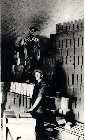
Unloading a kiln. ~1930 Claybank Brick Plant Site
The tossers would throw bricks to the Setters and the Setters would set the brick to be fired.
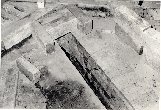
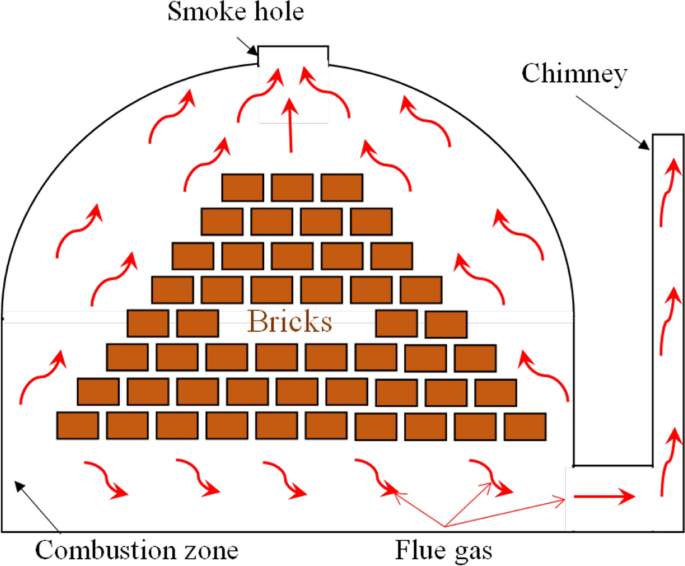
There was a flue in the floor of a kiln. Each of Claybank's 10 downdraft kilns have flues built into floor, these flues along with the smoke stacks create the perfect draft to ensure high temperature firing. ~1960 @ Claybank
A Kiln would be loaded to just above the inside straight walls and care was taken not to place brick over the Down Draft Flue Tunnels in the Kiln floor.
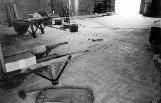
Interior kiln floor and wheelbarrows 5 December 2003
Claybank Brick Plant Site
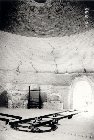
Kiln interior, showing the portable track and turntable used to move carts of green brick into the kiln for setting, 1993 Claybank Brick Plant Site
Once the kiln was loaded, the portable track system was removed, steel melts at about 1800 degrees F the kilns could be brought to about 2300-2500 degrees F depending on the type of brick being made.
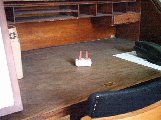
Pyrometric cones melted and bent over when certain temperatures were reached inside a kiln. Two or three cones (fingers) would be pushed into a block of clay and place in the Kiln within the view of a Peep Hole brick. A Pyrometric Cone bank would be place across the Kiln and viewed through a peep hole brick installed in the kiln doorway. This bank usually held three cones, each cone would melt at a different temperature showing the foreman or fireman when the kiln was getting close to the maximum firing temperature needed and when it was achieved. 2004 Claybank Brick Plant Site
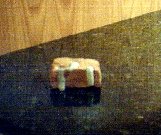
Pyrometric cones were used to monitor kiln firing temperatures. 23 January 2004 Claybank Brick Plant Site
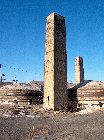
Smoke stack 3, 2003, prior to restoration of the base. Note also the deterioration of the top 5 December 2003 Claybank Brick Plant
During the firing process fumes and smoke were eliminated through the down draft fues and directed out a smoke stack. Each two kilns shared one smoke stack and are connected by underground flue tunnels.
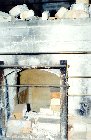
Cross section of a kiln floor showing down draft flue. Kiln foundations were eight feet deep and the floors were four feet thick. ~ 2000 Claybank Brick Plant Site
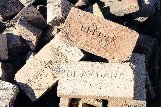
Some bricks had distinctive lettering. It took approximately five or six weeks to produce a kiln full of brick, 1 week to press the brick, 1 week in the drying Tunnels, 1 week to load the kiln, 1 week to fire the kiln, 1 week or more to cool and unload a kiln. For hand mold bricks, you would add an extra three days or so of hot floor drying. In a modern day tunnel kiln it only takes a number of days to produce the same amount of brick.
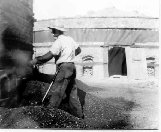
Ike Sluzer, 1937, Fireman @ Claybank.
When the Claybank kilns were still being fired by coal there was a young man hired as a fireman. He was told it would be his job to shovel coal to a kiln like the fireman in this picture. He was told to keep the kiln hot! He wanted to show the 'boss' what a good worker he was so he shoveled his heart out for a number of days. He did get the Kiln very hot and when he pointed this out to the boss it was discovered that he had raised the temperature far above what was necessary for firing the face brick it contained. (Face brick was usually made up of lower grade refractory clays and therefore was fired at lower temperatures). The kiln was cooled down as quickly as possible and when they unbricked the doorway it was found that the approximately 75,000 brick in the kiln had melted into one big brick! Air hammers were used to chip out the bricks and they recycled what they could as dobies. The young man didn't lose his job because after all he did prove that he was a very hard worker
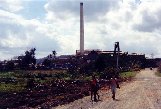
Refractory brick was sent to Cuba in the 1960's for their Sugar Mills, photo 2001
In the 1960's a young university student worked at Claybank during the summer months. The plant received a large rushed order from Cuba for high grade refractory brick for their Sugar Refineries. In order to get this order on the rail as soon as possible the wheelers were sent in to unload the kilns not at the usual temperature of about 100 degrees F but at something closer to twice that amount. The young man said that he had to take shallow breaths while in the Kiln as the heat would not allow him to breathe normally. He spent the least amount of time possible in the hot kiln, quickly loading up his wheelbarrow and heading for the doorway. When he left the kiln and went out into the summer heat he shook like a leaf because it felt so cold. He came down with the worst cold of his life that summer.

Interior kiln floor and wheelbarrows. When the bricks were cool enough to handle the Wheelers were sent into the kilns. They loaded and transported the new bricks via wheel barrow to waiting train cars or to be stored in the stock sheds. Claybank Brick Plant 2003.
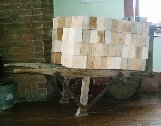
The Wheelers used Wheelbarrows to haul the fired brick from the kilns to the stock sheds or to waiting train box cars 23 January 2004 Claybank Brick Plant Site
As time went by a new improved wheelbarrow was introduced. It had a rubber wheel that was set farther back on the frame giving better balance and weight distribution.
There are more interesting facts about brickmaking at the Medora plant included in the Bernard Gray interviews on this website.